Thursday, 30 August 2018

My experience of getting an NG (Nasogastric) feeding tube for the first time


* Please note, I am not a qualified medical professional so I'd advise following the advice of your medical team.*

I've lived with a feeding tube since April 2015 due to functional/psychosomatic vomiting, this is where when I ingest things normally (via mouth) my body becomes on high-alert and sends the wrong signals to my stomach in the form of oral-intake being harmful to my body and in turn these wrong signals result in my inability to keep food down. When I first got an NG tube the idea was really daunting, I had no idea what to expect. I was in hospital for weeks and had started drastically losing weight (I'd lost 2 stone/28lbs/13kg in a very short space of time). I wasn't tolerating anything orally. I was told if trying just Ensure supplement drinks didn't work then we'd have to trial an NG tube. I remember feeling really scared so I did what people naturally do, Google search. For me it was a bad idea! It sounded absolutely terrifying and I pleaded with my body to tolerate supplement drinks, unfortunately it didn't so we had to place an NG tube. 

I had my boyfriend beside me the whole time which helped, it might help anyone who's having to get a feeding tube to have someone sit with them and help put them at ease. A nurse placed my feeding tube, it may however be a doctor who places your tube. The nurse explained the procedure and showed me the NG tube. I never realised a thin tube could be so daunting! Lubricant was placed on the end of the feeding tube that would be going into my nose. I was also handed a sick bowl and a cup of water with a straw. The tube is placed into your nose which can feel uncomfortable and can tickle the inside of your nose. It's then pushed gently to the back of your nose, following your nasal canal at a curve down to the back of your throat where your gag reflex is. You're effectively trying to swallow the tube down as it helps it bypass your gag reflex. I'd say this is the most difficult part and can be a little distressing. It can cause you to gag as if you are going to be sick. The biggest thing to remember is to breathe. It can cause your eyes to water from gagging. The person doing the procedure can stop and pull out the tube but if possible getting it done in a one is the best way and least distressing. Once it's past the back of your throat I'd personally say that's the worst part out the way. It's pushed gently down your esophogus into your stomach. Every hospital differs in how they check the tube is in place. Some take a syringe with a little air in it and push it into the tube whilst listening to your stomach with a stethoscope. Some send you for an x-ray of your chest to confirm it's not in your airway. Some places take a syringe and aspirate the NG tube, this is where you pull back with gentle pressure to produce some stomach contents and then a special strip called a PH strip is used to check the PH of the stomach contents. Some hospitals, including my own, may do a combination of 2 or all 3 of them. Once placement is confirmed as being in your stomach they flush the tube with some water. This isn't painful (for most people), it can feel a little strange, I describe it as drinking a glass of water but I'm not drinking. They then start feeds at a slow rate. NG tubes feel really weird at first, it's odd swallowing and having a tube in your throat but I found after a short while I forgot it was there. They can hurt your throat after a while, my advice for that would be: having a cold drink if you can tolerate it; gargling with salt water; throat lozenges; ice cubes; ice cream/ice lollies. I personally wouldn't say placement of a tube hurts, it can be uncomfortable but I wouldn't describe it as sore but everyone's experience is different. Something I would advise when the idea of an NG tube is suggested is to ask any questions you have about it, even if they seem silly, it can really help put your mind at ease and can make it seem less scary.

My DM's are always open ☺️ I'm happy to answer any questions about placement of a tube or about having a tube longer term. I've had an NG tube for the most part of the past 3 years. I was taught to self-insert them as for me they come out relatively frequently so it saves on trips to the hospital and I actually find it easier inserting them myself. The biggest thin
g to remember is an NG tube isn't the worst thing to happen and it's helping you out when you're struggling 


Tuesday, 22 May 2018

I remember...


I remember we sat together and watched the sun set, 
Your beaming brown eyes gazed into mine that I'll never forget. 
Your voice as though music echoed in my ears, 
Your velvet soft fingers wiped away my tears. 

I remember your smile brightening up my life, 
As you kissed me on the forehead and whispered "goodnight". 
We continued to watch the sun, 
Our hearts beat as one, 
The birds sat silently in their nests, 
As you continued to hold me to your chest. 

I remember daylight fading fast, 
I know that soon, everything would become the past. 
I remember how it felt to live a lie, 
Sometimes I just sit and wonder why? 

A lot of the time I don't understand, 
Why can't I just leave the past behind and forget? 
The kiss of your lips or the touch of your hands, 
There are moments I wish we'd never met. 

I wish that all of it wasn't real, 
I truly thought that this was my time to heal. 
It was just our time to separate and part, 
If only you didn't own my heart.


Wednesday, 16 May 2018

30 things about my chronic illnesses

1. The illnesses I live with are:
  • Brittle asthma
  • Multiple allergies
  • Anaphylaxis
  • Essential tremor 
  • Non-epileptic seizures 
  • Dissociative attacks (hallucinations, disorientation and confusion)
  • Acute urinary retention 
  • Secondary adrenal insufficiency 
  • Functional vomiting 

2. I was diagnosed with them in the year:
  • Brittle asthma (aged 15)
  • Multiple allergies (aged 15)
  • Anaphylaxis (aged 16)
  • Essential tremor (aged 14)
  • Non-epileptic seizures (aged 23)
  • Dissociative attacks (aged 23) 
  • Acute urinary retention (aged 19)
  • Secondary adrenal insufficiency (aged 21)
  • Functional vomiting (aged 22)
  • Hypoglycemia (aged 23)
3. But I have had symptoms since:

  • Brittle asthma (aged 14)
  • Multiple allergies (aged 5)
  • Anaphylaxis (aged 16)
  • Essential tremor (aged 8)
  • Non-epileptic seizures (aged 19)
  • Dissociative attacks (aged 22)
  • Acute urinary retention (aged 18)
  • Secondary adrenal insufficiency (aged 18)
  • Functional vomiting (aged 20)
  • Hypoglycemia (aged 23)
4. The biggest adjustment I’ve had to make is:


  • Being aware of my asthma triggers 
  • Reading the labels on every item of food to check it doesn't contain my allergens 
  • Using a feeding tube 
  • Taking daily medications 
  • Carrying emergency medications around with me 

5. Most people assume:

  • All asthma is, is taking a blue inhaler and then you'll be okay. However, for me and so many others it is so much more than that. 
  • People assume that anaphylaxis is just a food allergy and taking a tablet will make things better. The reality is anaphylaxis can kill if not treated properly. It is never just avoiding foods as it is not just foods that may contain your allergen. Many cosmetic products can also contain it. People assume depression is like having a bad day, things always get better in the morning. Sometimes it can be that way but other times you feel so low that you feel like there is no point anymore. 
  • As I use a feeding tube I don't eat or drink things normally. I still have to attempt to eat and drink normally as how will I know if I'm better if I don't try? 
  • People tend to think I'm either drunk or under the influence of drugs if I have a seizure or dissociative episode, this can sometimes deter people away from attempting to help me if this happens in public.


6. The hardest part about mornings are:

Waking up early. If I have been taking steroids to counteract inflammation then sometimes it causes steroid related insomnia which causes me to be awake for hours on end at night without being able to sleep even if I am tired. Some of my normal daily medications carry the side effect of drowsiness and it can be difficult to wake up if you are extremely drowsy.


7. My favorite medical TV show is:

Casualty! I cannot go without my weekly fix of Casualty. February 2013 I was granted a wish from the charity Dreams Come True. I chose to visit the set of Casualty (ironic that is haha).

8. A gadget I couldn’t live without is:


My mobile phone! Need I say anymore?


9. The hardest part about nights are:

Trying hard not to over think and get myself really stressed and worked up about nothing. 


10. Each day I take __ pills & vitamins. 

Morning: 6 medications (2 tablets and 4 liquids) and 2 inhalers 

Middle of the day: 4 medications (2 tablets and 2 liquids) 
Night time: 5 medications (2 tablets and 2 liquids) and 1 inhaler 


11. Regarding alternative treatments I:

Believe some work while others are just either people trying to make money out of people. I have personally tried something called The Salt Caves. I find it really helps to open up my airways, keep me out of hospital and stop any bacteria from causing me problems. It's been a complete life changer for me and has drastically improved my asthma symptoms as well as allowed me to decrease the amount of medication I am using.


12. If I had to choose between an invisible illness or visible I would choose:


On my bad days I would chose to have a visible illness because even on bad days people still have something judgemental to say. I've been accused of over-exaggerating, had people tell me to "just get over it" as well as people trying to claim that I'm making things up. I think if people can see an illness they treat you differently to if they cannot see one. 


13. Regarding working and career:


Education and work have been really difficult for me with chronic illnesses. I had to take a lot of time out of education due to being ill. However, it has not affected me dreams. It makes me a lot more determined to achieve the things I desire. The biggest example of this is when I strived to get to University and through a lot of hard-work and determination, I got there. 


14. People would be surprised to know:

I do not constantly put everything about my illness over social media. I don't always let people know when I have been admitted to hospital.


15. The hardest thing to accept about my new reality has been:


Giving up some of the things I used to love, taking medications daily to keep me alive and as okay as possible, the horrible side-effects of steroid medication and having to stop eating foods I once enjoyed. 


16. Something I never thought I could do with my illness that I did was:


Get to University. Despite struggling, I got there in the end.


17. The commercials about my illness:

Help raise awareness of my reality and everything I go through on a daily basis.

18. Something I really miss doing since I was diagnosed is:

Going on holiday, I haven't been abroad in a number of years (8 years), it's something I'd love to do again.


19. It was really hard to have to give up:

Nuts and peanuts.


20. A new hobby I have taken up since my diagnosis is:


Writing.


21. If I could have one day of feeling normal again I would:

Enjoy eating whatever I like without having to worry about what the food contains and whether or not it's safe for me.
22. My illness has taught me:

Who truly matters in life. The people who never judge you no matter what and have been there the whole way through without walking away or treating you differently are the ones who deserve to be in your life. 

23. Want to know a secret? One thing people say that gets under my skin is:

"It's just a cold"...to someone with a normal immune system a cold is a slight sniffle, maybe at worse you need to take a day or two off work to stay in bed...however to someone with severe asthma a cold is not just that. A cold is like the flu 100 times over. It's a potential chest infection, a large chance of ending up staying in hospital and maybe even a stay in intensive care or high dependency. 

24. But I love it when people:

Treat me the same as any other person my age. 

25. My favorite motto, scripture, quote that gets me through tough times is:


"You were given this life because you are strong enough to live it"

26. When someone is diagnosed I’d like to tell them:

Even though it is going to be hard things do get easier.

27. Something that has surprised me about living with an illness is:

You value the little things (such as: getting dressed, going to University, managing a week healthy) so much. Even though to others they are not big things, for you and others with chronic health issues...they are everything. 

28. The nicest thing someone did for me when I wasn't feeling well was: 


Held my hand, hugged me, told me everything would be okay in the end. 


29. I’m involved with Invisible Illness Week because:


96% of chronic illnesses are invisible...more awareness needs to be raised. 


30. The fact that you read this list makes me feel:


Maybe you finally understand somewhat of what I go through.

Monday, 14 May 2018

Mental Health Awareness Week 2018


14th May 2018 marks the start of mental health awareness week, a week dedicated to raising awareness of a very un-talked about, hidden away subject that will affect us all at some point in our lives. Whether it's ourselves affected or someone we know who's live is impacted by mental illness this week is dedicated to destroy the stigmas attached to living life with a mental health problem.
In the UK alone each year 1 in 4 people will live alongside a mental health problem. I am part of the 1 in 4 statistic.
Many mental health problems exist. There's more commonly talked about ones such as: depression, anxiety, obsessive compulsive disorder, bipolar, schizophrenia etc. however, there's also less commonly known about ones such as: seasonal affective disorder, dissociative disorders, somatic symptom disorders, psychosis, borderline personality disorder etc.
I personally live with: somatic symptom disorder (I have psychosomatic vomiting and pain); social anxiety; depression; panic attacks; dissociative/non-epileptic seizures and dissociative attacks (I hallucinate, become disorientated and confused).
Mental health problems are scary to live with! You spend your time living with a lot of unanswered questions and unknowns. Mental health problems are not a joke despite what modern society often leads us to believe. Mental health problems follow you wherever you go. Someone living with depression still has depression in spite of them smiling through the day, someone living with anxiety still lives with anxiety despite them speaking in social situations, someone living with an eating disorder still lives with an eating disorder in spite of them eating, someone living with paranoia still lives with paranoia in spite of them trying not to let it interfere with their relationships etc. You cannot just up and get on with it, leaving your mental health problem behind.
People view mental health problems very differently to the way physical problems are viewed however mental health problems affect nearly all of us at some point in our lifetime and in a lot of ways affect more people than physical health conditions. You wouldn't say to someone having an asthma attack "cut it out and just breathe for crying out loud!"; "I understand that you can't stop vomiting but you just need to make an effort with your life!"; "Have you ever tried just not having cancer?" but some how it's okay to tell people with mental health conditions to just "get on with it" to make them feel like they're not even making an effort to live their life or speak about their condition as though it were as simple as not speaking about the condition anymore and it'll disappear.
We all deserve to be listened to when we are struggling with our mental health. We all deserve to have someone we can turn to say to them "I'm really not okay". We shouldn't be made to feel ashamed because we're struggling. We shouldn't be made to feel crazy because we are living with something out with of our control. If those suffering with mental health conditions could they'd chose not to have the condition but it's not a choice.
#endthementalhealthstigma #mentalhealthawareness #awareness #itsokaytonotbeokay #mentalillness #mentalhealth #mentalhealthawarenessweek #1in4 

9 things I wish I could tell my younger self regarding my allergies and anaphylaxis

I, like a lot of people, sometimes wish I could go back in time. Whether it means I could have the possibility of fixing a mistake, saying goodbye to someone or just to give my younger self some advice. This blog will be focusing on things I wish I'd told my younger self on first being diagnosed with allergies and subsequently anaphylaxis.

  • "Always carry your medications and have them easily available." I've had a few occurrences where I had no medication with me and suffered anaphylaxis when out, even though it taught me a major life lesson it terrified me to the max and encouraged me to take my medication wherever I go (even if it's going out for a few minutes), it can truly be the difference between being alright to suffering life-altering/fatal consequences. Furthermore always ensure you carry 2 adrenaline pens at all times as something could go wrong regarding the first dose of adrenaline: the adrenaline pen could have been damaged or misfired etc.. Current BSACI (British Society of Allergies and Clinical Immunology) guidelines state that 2 adrenaline auto-injectors have only to be supplied to people who are: obese, live in a rural location and/or have previous reactions classed as life-threatening. The 'Carry 2' campaign are trying to get the BSACI to change their guidelines and have set up a petition which has reached over 50,000 signatures! The petition to change the BSACI's guidelines can be found here as well as any information you may need about adrenaline pens: http://adifferentsortoflife.blogspot.co.uk/2017/12/carry-two-adrenaline-auto-injectors.html


  • "Double and then triple check food items you pick up to eat in shops (even if it's something you have been previously alright with as things could have changed, it's quite common for brands to change their manufacturing process or their factory etc.)." It only takes one bite of something to cause anaphylaxis (severe allergic reaction). Changes can include: adding a "may contain" warning or adding the specific allergen into the food. 


  • "Administering an adrenaline pen sounds terrifying but on administering it it's not as scary or daunting." My first reaction I was in tears as I didn't want to give it. I was scared it was going to hurt as I absolutely hated needles. On administering it I realised that it definitely wasn't as painful as anticipated and it in turn stopped my reaction from developing any further. My leg carried a dull ache with it for a few days however I am thankful I administered it. What can be helpful is getting a trainer auto-injector which allows you to practice with a device with no needle which looks identical to the real thing. More information on how to use adrenaline auto-injectors and where to source a trainer pen can be found here: http://adifferentsortoflife.blogspot.co.uk/2017/12/how-to-use-epipen-jext-pens-and-emerade.html


  • "Having allergies doesn't mean you have to miss out." When I was first diagnosed it was very disheartening to constantly pick up things and find that they were may contain. Some of my much loved treats were now out of the question for me to consume. I was often led to feel left out when it came to parties and events where the food couldn't be guaranteed as safe for me. With time I've discovered many safe options that I've come to love and taste absolutely delicious. Many supermarkets now have 'free from' sections where they have foods that are free from specific allergens however, please note, that these items still need to be throughly checked as being in the free from section doesn't automatically mean it'll be free from the specific allergen you are avoiding.


  • "Don't be ashamed about your allergies and anaphylaxis, they're nothing to be embarrassed about and you shouldn't feel the need to hide them away and keep them very hush hush." People may not understand allergies and anaphylaxis however on explaining the conditions to them people tend to become a great deal more understanding


  • "Your allergies do not define you." You have allergies but they are not the person you are, there's much more to you as a person than a series of allergies and a list of conditions. In that respect you should be more you and not your allergies and anaphylaxis.


  • "Don't beat yourself up if you do take an anaphylactic reaction." Too many times after suffering from a severe allergic reaction I've felt complete anger and upset at myself. I tend to ask myself many questions including: "Why wasn't I more careful?" "Why didn't I realise this wasn't safe?" In many ways, in situations such as this, I've often felt that I don't have the right to be upset about reacting as somehow I should have been more careful. It's taken me quite a long time to realise that I'm only human, sometimes I make mistakes when reading things or sometimes there's no explanation as to why I reacted, the product doesn't contain my allergens and there's no may contain warning either. 


  • "Things seem really daunting now but with time it becomes easier." When I was first diagnosed I remember feeling completely overwhelmed. Allergies and anaphylaxis had thrown me into this complete new world and I felt like I was drowning trying to keep on top of everything. I never thought things would get easier but I am happy to report that for me, with time, my allergies and anaphylaxis have become easier to live with. Don't get me wrong they are still scary and sometimes I do feel terrified however things like checking labels is now second nature to me and I'm very aware of things I know definitely to avoid and things that are more likely to be safe. 


  • "It's okay to feel like things are too much." I've a very bad habit of beating myself up if I feel like I am struggling. Even to this day, nearly 8 years after my first severe allergic reaction, I need reminding of this. I often feel like I'm not allowed to feel like I'm struggling with everything however it's okay to feel like you don't want to deal with everything that's going on and that you wish things were easier, you're only human. 


Monday, 7 May 2018

Reviewing the Buxom Lash Mascara

A few months ago I joined the 'Glamour Beauty Club'. This is something I'd seen posted about in a Facebook group I'm in and I was very intrigued. Glamour Beauty Club is a free service where you become a member and they send out sample products for you to review. I'd seen a host of different items reviewed and I personally couldn't wait to join to see what, if anything, I'd be sent to review. When you become a member you create a beauty profile filled with information about you and your overall beauty routine (hair, make-up etc.), they then cater what they send you to your beauty profile so the things they send you are more likely to be things you'll want to use. After receiving and using the product they ask you to let them know what you thought of the product so they have feedback on all the different products.

I was amazed to receive an email less than a week after signing up inviting me to try out a sample of a mascara. The particular brand I'd never heard of but on looking it up it looked really promising and I was more than eager to accept the invitation to try it. The product I was invited to try was the 'Buoxm Lash Mascara'.


The product arrived a few days later and I was excited to get stuck in. Along with the item they send you a card letting you know what the item is. I was surprised to see that the product sample size was actually quite big, it was 6ml which is a good amount for a makeup sample item considering the full-size version is only 5ml bigger at 11ml. It came in a nice silver box and the mascara itself has a silver top with a black bottom. 


The description of the mascara on the website reads: "With this U.S. best-selling, volumising mascara, you'll get big, outrageously full lashes with curves to spare. The vitamin enriched, clump resistant formula deepens, darkens and thickens lashes while the hourglass shaped brush evenly coats lashes, from root to tip, for perfect separation and definition. Longwearing, vitamin enriched formula. Smudge and clump resistant. Blackest black." Something I was interested to see was what the wand of the mascara would be like, with other mascaras I find I don't like them as much solely due to the wand they have, I am not the biggest fan of "fluffy" wands and more prefer wands that carry small bristles that are the same material as the wand itself. I was happy to find on opening the mascara that the wand was the type I was hoping for. It was a good sized wand and seemed to hold a decent amount of product on it.


On applying the mascara I found that it was extremely easy to apply and seemed to glide on. It didn't take too many strokes to build up a good coat and didn't feel heavy on my eyelashes like I've experienced with other mascaras before. I absolutely fell in LOVE with this mascara! I definitely would agree with the description of the product. I found that it was volumising for my lashes, it was completely lacking in clumps, the product was evenly distributed throughout my lashes and in my opinion it's one of the best mascaras I personally have come across. I'd definitely recommend this product to anyone who is looking for a good mascara for a reasonable price (the full price retails at roughly £16) that does exactly as it advertises it should do. I cannot wait to continue using this product and when my sample size runs out I will definitely go on to purchasing a full-size version of the product.


For more information on this mascara check out:

For more information on becoming a member of Glamour Beauty Club check out: 

When people hear about my illnesses and ask "How do you do it?"

“How do you do it?” is one of the major questions I receive from people when they find out about all my health problems, as well as those who see me continuing to battle on a daily basis. I never really know how to give a simple answer to that question. I guess it is really difficult for someone who is healthy to understand how a sick person functions. They try to imagine how their life would be if they had the illnesses I have, but it is impossible for them to do so. I’ve had friends watch me go through so much in my nine year battle with chronic health problems. They have been there through the good and the bad bits, but the reality is that the majority of people do not stick around long enough to see that I am a person just like everyone else.
I have come across the people who try to be polite about it, but what most are really trying to say is they want nothing to do with you because your life brings too much drama due to being sick.
You then have the people who start of like the perfect person. They are supportive, caring, kind and listen to you when you are having ups and downs. After a while, though, this wears off and you almost see their true colours underneath. They talk about you behind your back to other people. They tell about how they think you’re “a drama queen,” how you “attention-seek,” and how “over-dramatic” you are. Some even go as far as to question whether or not you are ill when you say you are. These people do not intentionally set out to hurt you, but for the most part you end up getting hurt.
Nobody should have to lose someone important to them due to something out with their control. However, as the years have gone by, I’ve lost various people who at one point meant everything to me. I have come to think that losing people is a part of living life with a chronic illness.
It is not, however, always a negative situation. Through everything I have come to realize who should truly matter to me. The people who have stuck by me through everything, have never let chronic illness get in the way and have never let me down. They never judge me even though sometimes I give them every right to and they never think I am over-exaggerating or being dramatic when I am having a bad time. I have very few people in my life whom I can truly rely on through everything. I do not blame people for not being able to handle my health issues. After all, it is very out of the ordinary and not something you really want to deal with all the time.
So going back to my question of, “How do you do it?” I guess my answer is a simple one. I just have to do it. There is no easy solution or easy way to explain it, other than I have to get through things. I have endured over nine years of chronic health problems and I have had to come to terms with a lot of things. Some of them are things that no young adult should have to think about such as:
“When is my next hospital admission?”
“What side effects could this medication give me?”
“Could this condition prove fatal?”
Others are limitations which have become apparent over the years. Things such as:
“I cannot pass my exams this year.”
“I am struggling to walk up the stairs without gasping for breath.”
“I cannot eat that because it may contain nuts.”
Sometimes it does seem like a never-ending struggle that never gets any easier, but there are many positives I have come across regarding my battle.
I feel I am more motivated than I would have been had I not gotten ill. I was so much more determined to pass my exams and to get into university when I started to struggle with my health than when I was healthy. I never let anything get in the way of my education. It did not matter that I had to repeat my last year of school or attend a seven week long summer school whilst most other people my age were out partying and galavanting away on holiday somewhere nice. I achieved something that so many thought I would not – I got to university.
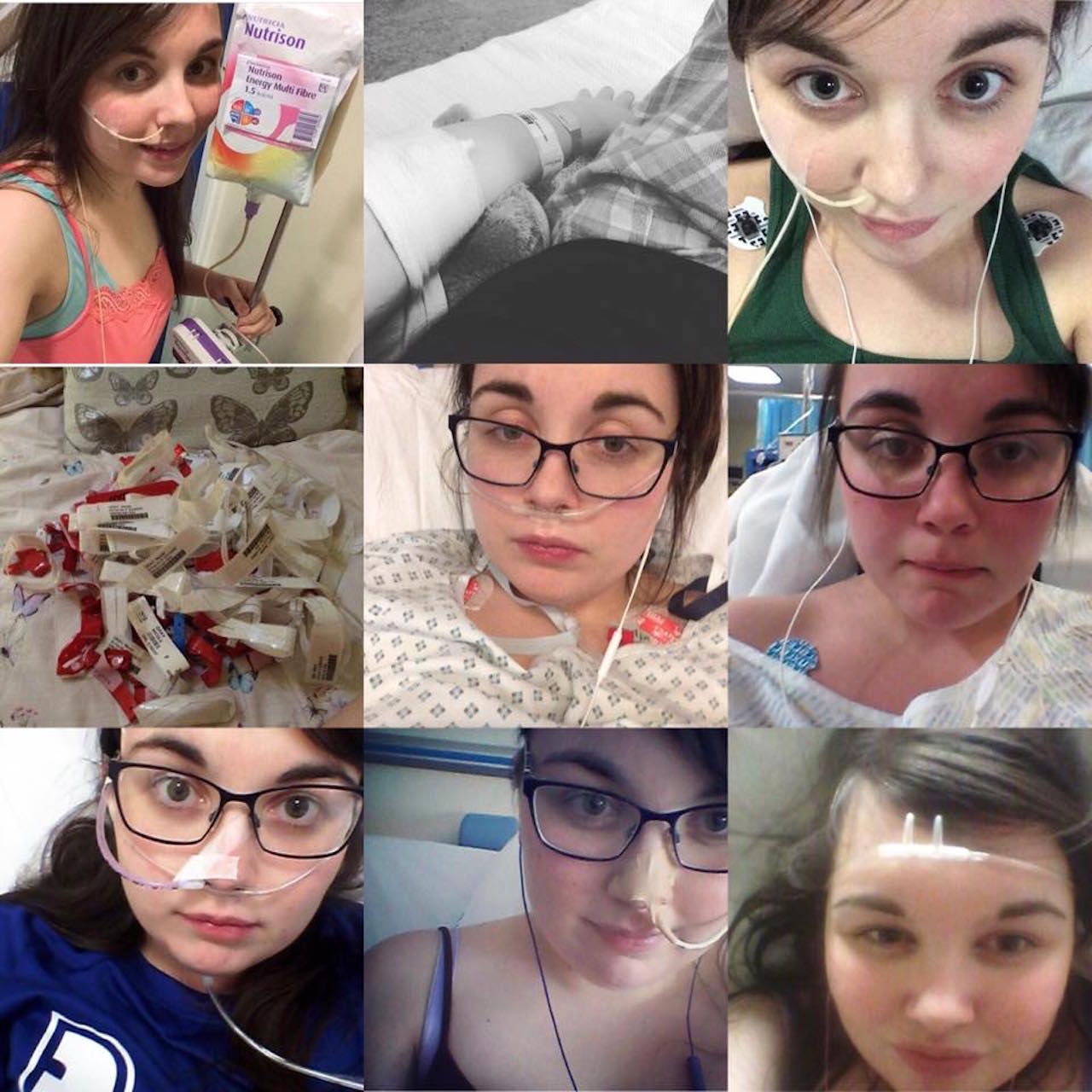
A nine photo collage of the writer showing different pictures during her time being ill.
Although it was more short-lived than I’d initially expected, I still gained a lot of great experiences and life skills from my time spent at university. After an initial first year and failing to complete my yearly exams due to my health and hospital admissions, I made the decision to repeat my first year in the hopes of passing the year. Unfortunately, after a second attempt at first year I was still struggling a great deal, and again hadn’t managed to complete the exams. It was then I made the heartbreaking decision to withdraw from my full-time university course I’d worked excessively hard to get into. I felt like a complete failure and like I’d let myself down so much
A short while later, I came across “The Open University.” It’s a university which provides part-time courses via distance learning. (Most or all of the learning is done via textbooks and/or online aids). I decided to apply for a part-time study course and have been a distance learning part-time student since. Although it was really hard having to accept withdrawing from full-time education, it’s also been somewhat of a blessing in disguise as distance learning has proved to work a lot better for me. I feel much more motivated and now have the ability to catch up any work I may have missed. Yes, it has proved no easy task, and yes, I still have moments where it seems like I just want to give up – but I feel more determined than I have ever been. I want to do well and pass my university degree.
I live for today. Before my health issues truly started, despite being young, I tended to dwell upon the past a lot. I would focus on the bad things that had happened and often wondered if things would get better. Now things are so different. I think about the past, but it is no longer the bane of my life. I live each day at a time. Today could be horrible and I could struggle through, but the reality that so many do not realize is that tomorrow could be so much better – it could be the happiest day of your life. I think about the things that my future may hold, but for the most part, I have hope for tomorrow. I always try to smile everyday, even if I am at the lowest of the low points and feeling like giving up. I think about the positive things in life such as my friends, my boyfriend, my family and the things I have to look forward to. These all help me get through the dark times.
In a lot of ways I am grateful for my health problems. They have caused so much pain, anguish and hurt in my life, as well as those around me. However, they have also brought hope. They have made me value the little things in life such as getting up in the morning, putting on clothes, cooking for myself – as well as the big things in life, such as finishing high school and moving out for the first time.
Like anyone I cannot predict the future. I do not know what will happen tomorrow, let alone in years to come. What I do know is I will continue to be forever grateful for those people who make my life even that little bit easier. The people who make me smile when I’m at my lowest point, who bring light at the darkest of moments and who just generally make life a better place to be. Life should not be about having lots of money or having the best job. It should be about being the best person you truly can be, as well as surrounding yourself with people who bring out the best in you.